Deep Learning in the Cloud
AI_INFN, Artificial Intelligence Technologies for INFN

In 2023, I proposed to the Fifth Committee of INFN, focusing on Technological Research, the initiative AI_INFN to explore Cloud-Native Technologies for Artificial Intelligence.
AI_INFN operates a mini-farm with O(1000) cores and O(10) high-end GPUs and FPGAs using Kubernetes on OpenStack for provisioning.
AI_INFN offers a JupyterLab interface covering the needs of dozens of users, and several other solutions for advanced R&D.
Resources
- 🌐 Website: ai.cloud.infn.it
- 📚 Docs: ai-infn.baltig-pages.infn.it
- 📧 Mailing list: ai-infn-csn5@lists.infn.it
Publications
- L. Anderlini et al., "The AI_INFN Platform: Artificial Intelligence Development in the Cloud", [arXiv:2509.22117], Computer Science, 26(SI)
- L. Anderlini et al., "Supporting the development of Machine Learning for fundamental science in a federated Cloud with the AI_INFN platform", [arXiv:2502.21266], EPJ Web Conf. 337, 2025
- L. Anderlini et al., "ML_INFN project: Status report and future perspectives", EPJ Web Conf. 295, 2024
InterLink - Kubernetes to Everything
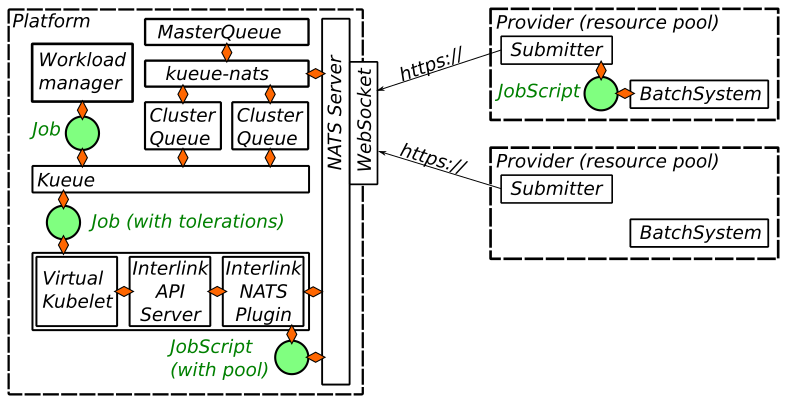
I contribute to InterLink, a Free and Open Source Software provider for Virtual Kubelets, enabling the offloading of compute tasks from Kubernetes Cluster to remote computing sites.
My primary interest in InterLink is extending the computing power available through the AI_INFN initiative using INFN resources provisioned through SLURM, HTCondor or Kubernetes in other computing sites.
My main contribution to the project concerns early adoption and commissioning in my other research activities.
I have also created my own plugin to connect resource providers I can access opportunistically, via a NATS websocket.
Resources
- 🌐 Website: interlink-project.dev
- INFN AI Strategy 2024
- NATS plugin: interlink-nats-plugin (drafted docs)
Presentations
- L. Anderlini, "The INFN Infrastructure for Artificial Intelligence" presented at the AI@INGV day, June 9th, 2025
- L. Anderlini, "INFN Infrastructure for Artificial Intelligence", presented at the INFN Computing Workshop in 2025
- L. Anderlini et al., "Enabling the compute continuum at ICSC: A solution based on interLink" presented at the 110° Congress of the Italian Physical Society (SIF 2024)
Full Carbon 3D Detectors
Fabrication of the Sensors with Femto-Second Laser Pulses
In 2020, in the context of the INFN initiative "TIMESPOT", I fabricated full-carbon sensors by engraving electrodes in a mono-crystal diamond specimen.
If sufficiently short, laser pulses can induce a phase transition in carbon, from diamond (a semiconductor) to graphite (a conductor). The duration of the laser pulse and the shape of the focus are critical because the laser can induce another phase transition from graphite to amorphous carbon, which is a much worse conductor than graphite.
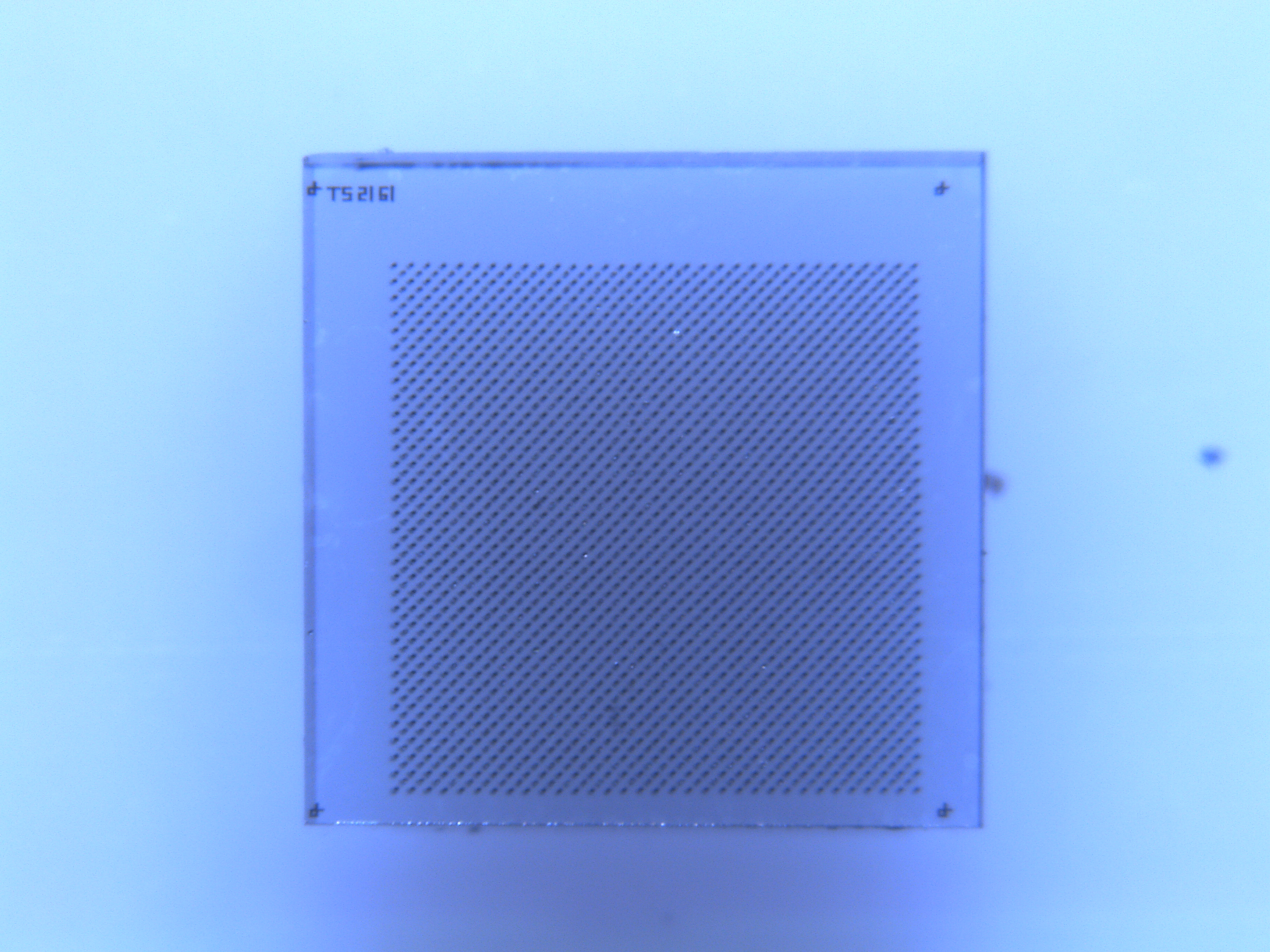
In a beam test in 2021, those sensors reached the time resolution of 80 ps with a matrix of 55 × 55 μm2 pixels.
In 2022, we have demonstrated that the same electronics used to read Silicon sensors with timing can be bump-bonded to diamond sensors.
Since then, we have started a deep upgrade of the laser-graphitization infrastructure that will be completed in 2026.
Publications
- L. Anderlini et al., "Fabrication and Characterisation of 3D Diamond Pixel Detectors With Timing Capabilities", Front. Phys. 8 (2020)
- L.Anderlini et al., "A 4D diamond diamond detector for the HL-LHC and beyond", NIM A, 1040 (2020) 167230
- A. Loi et al., "A prototype 4D-tracking demonstrator based on the TimeSPOT developments", JINST 19 (2024) C02069
Simulating Sensors with Resistive Elements
The time resolution of 3D diamond sensors is limited by the high resistivity of the engraved electrodes.
To make informed decisions in the optimization of the sensor, such as the geometry, I studied a novel method to simulate devices with resistive electrodes.
The new method is built on an extended version of the Ramo-Shockley Theorem introducing time-dependent weighting potentials, encoding the information on the capacitance and resistance of the sensor.
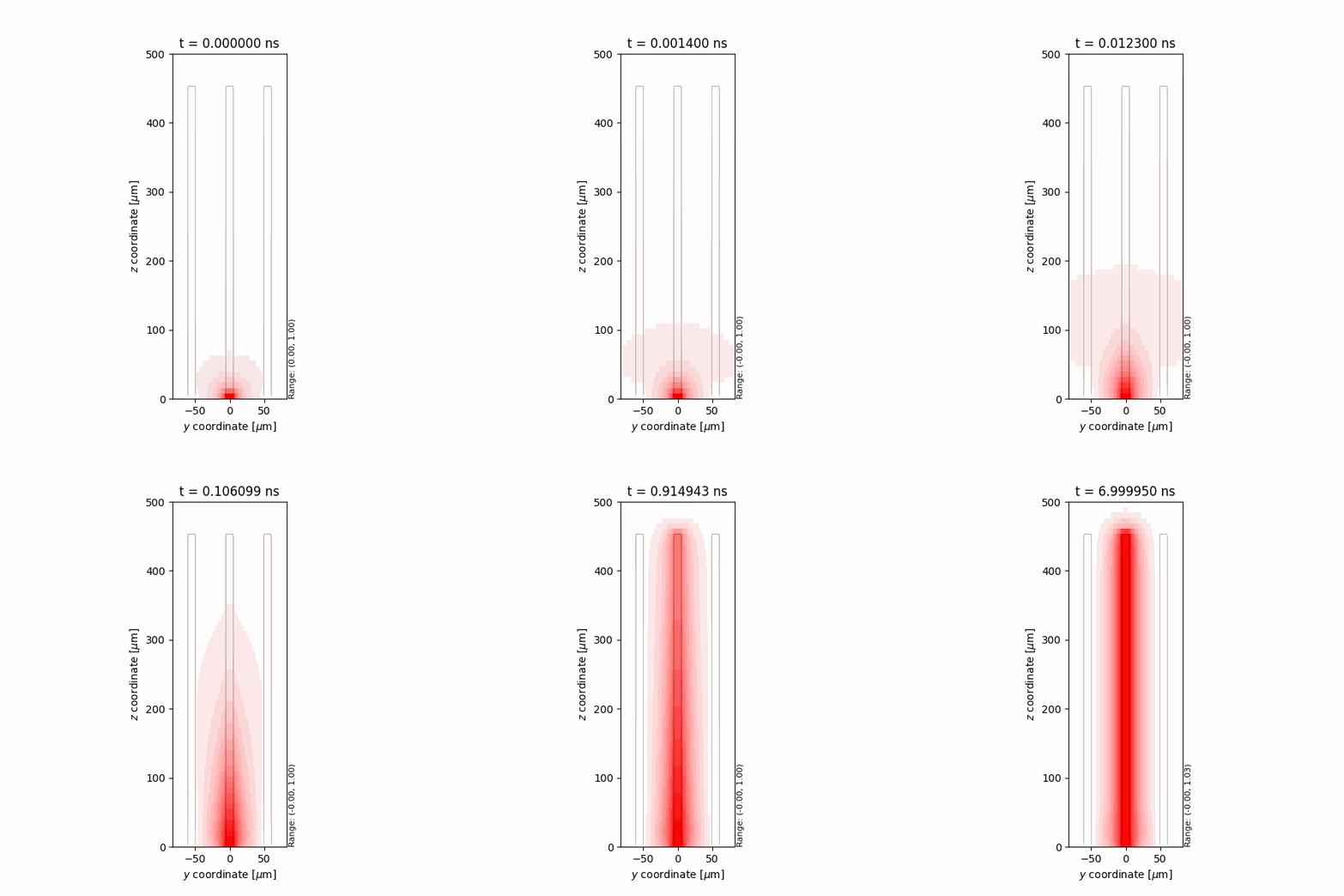
I have also contributed to an explorative study to employ Physics-Informed Neural Networks to solve the Partial Differential Equation to compute the time-dependent weighting potential.
I am currently porting the simulation to GPU and employing it to explore various geometries and configurations.
Publications
- L. Anderlini et al., "Optimization of 3D diamond detectors with graphitized electrodes based on an innovative numerical simulation", JINST 21 (2026) P01008
- A. Bombini et al., "Physics Informed Neural Networks for design optimisation of diamond particle detectors for charged particle fast-tracking at high luminosity hadron colliders", [arXiv:2509.21123]
- A. Morozzi et al., "3D Diamond Tracking Detectors: numerical analysis for Timing applications with TCAD tools", JINST 15 (2020) C01048
Computing for the LHCb experiment
As member of the Offline Resources Task Force of the LHCb Collaboration since January 2025, I contribute to the annual reports on the usage of computing resources and on the requests to the funding agencies based on forecasts to the upcoming years.
I take the opportunity to practice with OLAP technologies such as ClickHouse and DuckDB to organize data in interactive Grafana dashboards displaying how LHCb uses computing resources.
I my capacity of National Representative of Computing for LHCb-Italy, I defend the LHCb requests in front of INFN.
Public notes
- L. Anderlini et al., *LHCb Computing Resources: preliminary 2027 requests",
LHCb-PUB-2025-010 - C. Bozzi et al., *LHCb Computing Resources: 2026 requests",
LHCb-PUB-2025-006 - LHCb Collaboration, Utilization of LHCb Offline Computing Resources in 2024,
LHCb-PUB-2025-007
Presentations to the INFN referees
- L. Anderlini, LHCb computing requests for 2026, Frascati, September 4th, 2025, [agenda]
- L. Anderlini, LHCb computing requests for 2025, Bologna, September 4th, 2024, [agenda]
- L. Anderlini, LHCb computing requests for 2024, Rome, September 7th, 2023, [agenda]
- L. Anderlini, LHCb computing requests for 2023, Rome, September 6th, 2022, [agenda]